Rashtrapati Bhavan
The viceroy's house Edwin Lutyens built for the British Raj, handed to the President of India in 1950, and the ledger of every president and prime minister since independence.
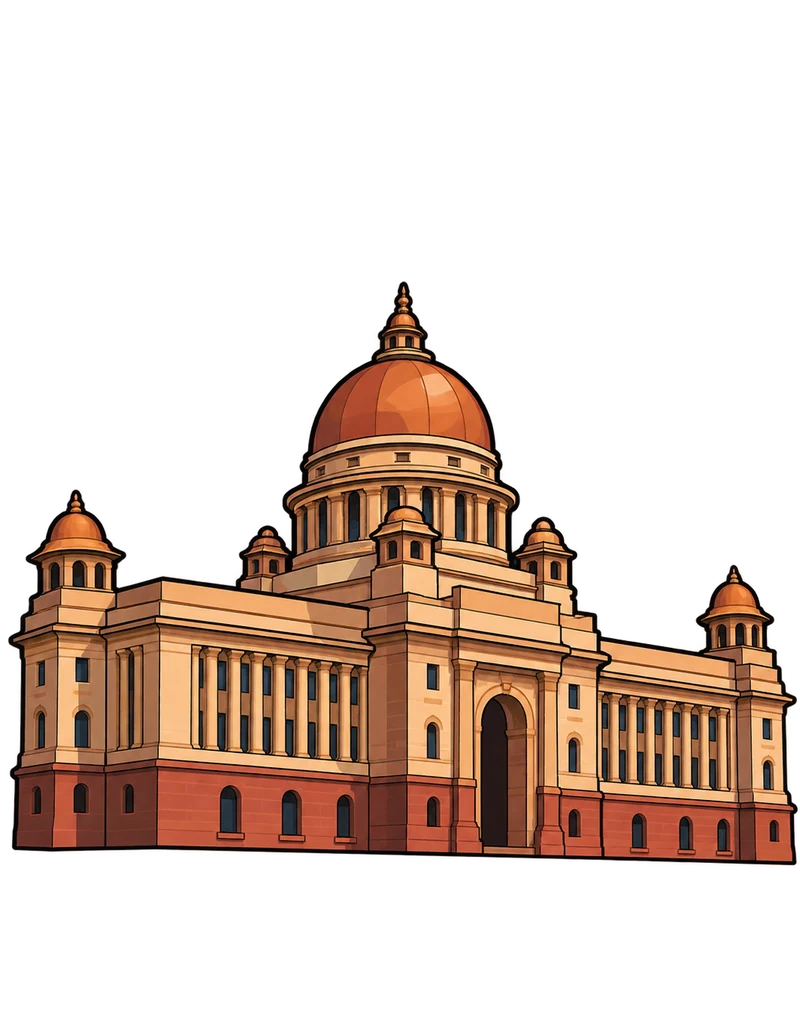
Rashtrapati Bhavan, "the President's House," stands at the top of Raisina Hill in New Delhi. From its forecourt, the ceremonial avenue Kartavya Path runs east to India Gate. It was built as the residence of the British viceroy and is one of the largest homes of any head of state in the world, with about 340 rooms.
| Building | Rashtrapati Bhavan |
|---|---|
| What Wikidata calls it | official residence |
| Capital | New Delhi |
| Form of government | federal parliamentary republic |
| Population | 1,326,093,247 |
The building
In 1911 the British announced that the capital of India would move from Calcutta to a new city at Delhi. The architect Edwin Lutyens designed the viceroy's house as its center. Construction ran from 1912 to 1929, and the first viceroy to live there, Lord Irwin, moved in in 1931. The design mixes a classical European plan with Indian elements: a copper dome that recalls the Buddhist stupa at Sanchi, chhatris on the roof, and jalis, pierced stone screens. The building is faced in red and cream sandstone from Dholpur.
India became independent in 1947. When the constitution took effect on 26 January 1950, Rajendra Prasad became the first president, and the house took its present name.
Who held the office
The ledger records 18 presidential terms. The count is higher than the number of presidents because it includes three acting holders:
- V. V. Giri acted after Zakir Husain died in office in May 1969, then resigned to stand in the election.
- Mohammad Hidayatullah, the Chief Justice, acted for a month while the election was held. Giri won it.
- B. D. Jatti, the vice president, acted in 1977 after Fakhruddin Ali Ahmed died in office.
Droupadi Murmu, president since July 2022, is the first president from one of India's Scheduled Tribes.
| # | Held by | From | To | Party |
|---|---|---|---|---|
| 15 | Droupadi Murmu | July 25, 2022 | incumbent | |
| Ram Nath Kovind | July 25, 2017 | July 25, 2022 | ||
| 13 | Pranab Mukherjee | July 25, 2012 | July 25, 2017 | |
| Pratibha Patil | July 25, 2007 | July 25, 2012 | ||
| A. P. J. Abdul Kalam | July 25, 2002 | July 25, 2007 | ||
| K. R. Narayanan | July 25, 1997 | July 25, 2002 | ||
| Shankar Dayal Sharma | July 25, 1992 | July 25, 1997 | ||
| 8 | R. Venkataraman | July 25, 1987 | July 25, 1992 | |
| 7 | Zail Singh | July 25, 1982 | July 25, 1987 | |
| Neelam Sanjiva Reddy | July 25, 1977 | July 25, 1982 | ||
| Basappa Danappa Jatti | February 11, 1977 | July 25, 1977 | ||
| Fakhruddin Ali Ahmed | August 24, 1974 | February 11, 1977 | ||
| 4 | V. V. Giri | August 24, 1969 | August 24, 1974 | |
| Mohammad Hidayatullah | July 20, 1969 | August 24, 1969 | ||
| V. V. Giri | May 3, 1969 | July 20, 1969 | ||
| 3 | Zakir Husain | May 13, 1967 | May 3, 1969 | |
| Sarvepalli Radhakrishnan | May 13, 1962 | May 13, 1967 | ||
| 1 | Rajendra Prasad | January 24, 1950 | May 12, 1962 |
18 tenures. Source: Wikidata, retrieved 2026-09-23.
Where the power sits
India is a parliamentary republic. The president is elected indirectly, by the members of Parliament and the state legislatures, and acts on the advice of the Council of Ministers. The prime minister leads that council and must command a majority in the Lok Sabha. The ledger records 18 prime-ministerial terms held by 15 people, from Jawaharlal Nehru on 15 August 1947.
| # | Held by | From | To | Party |
|---|---|---|---|---|
| 15 | Narendra Modi | May 26, 2014 | incumbent | |
| 13 | Manmohan Singh | May 22, 2004 | May 26, 2014 | |
| Atal Bihari Vajpayee | March 19, 1998 | May 19, 2004 | ||
| 12 | Inder Kumar Gujral | April 21, 1997 | March 19, 1998 | |
| 11 | H. D. Deve Gowda | June 1, 1996 | April 21, 1997 | |
| Atal Bihari Vajpayee | May 16, 1996 | June 1, 1996 | ||
| P. V. Narasimha Rao | June 21, 1991 | May 16, 1996 | ||
| Chandra Shekhar | November 10, 1990 | June 21, 1991 | ||
| 7 | V. P. Singh | December 2, 1989 | November 10, 1990 | |
| Rajiv Gandhi | October 31, 1984 | December 2, 1989 | ||
| 3 | Indira Gandhi | January 14, 1980 | October 31, 1984 | |
| 5 | Charan Singh | July 28, 1979 | January 14, 1980 | |
| 4 | Morarji Desai | March 24, 1977 | July 28, 1979 | |
| 3 | Indira Gandhi | January 24, 1966 | March 24, 1977 | |
| Gulzarilal Nanda | January 11, 1966 | January 24, 1966 | ||
| Lal Bahadur Shastri | June 9, 1964 | January 11, 1966 | ||
| Gulzarilal Nanda | May 27, 1964 | June 9, 1964 | ||
| 1 | Jawaharlal Nehru | August 15, 1947 | May 27, 1964 |
18 tenures. Source: Wikidata, retrieved 2026-09-23.
Last updated September 22, 2026.